


Poultry has been a mainstay of my local farm economy for decades. The 2022 USDA farm census showed nearly 8 million “broilers and meat-type chickens” on farm in my home county Amelia, Virginia. Amelia’s 2022 poultry and egg production was over $65 million market value. That was 81% of the entire crop Amelia farm crop value. Yet Amelia ranked only sixth among Virginia’s poultry-producing counties that year. Our neighbor to the south—Nottoway County—reported just over 7 million birds in that same census, ranking 8th in poultry production among Virginia counties with $42 million in market value. That was also 81% of Nottoway’s ag product market value. We favored broiler chickens here in south-central and southside Virginia. The number one poultry-producing county in Virginia that year was Rockingham, in the Shenandoah Valley, where turkeys are big. Rockingham’s combined market value of chickens, eggs, and turkeys was $1.2 billion. Wow. That year (2022), Virginia ranked only ninth among US states in broiler chickens. Georgia, Alabama, and Arkansas were the top three.
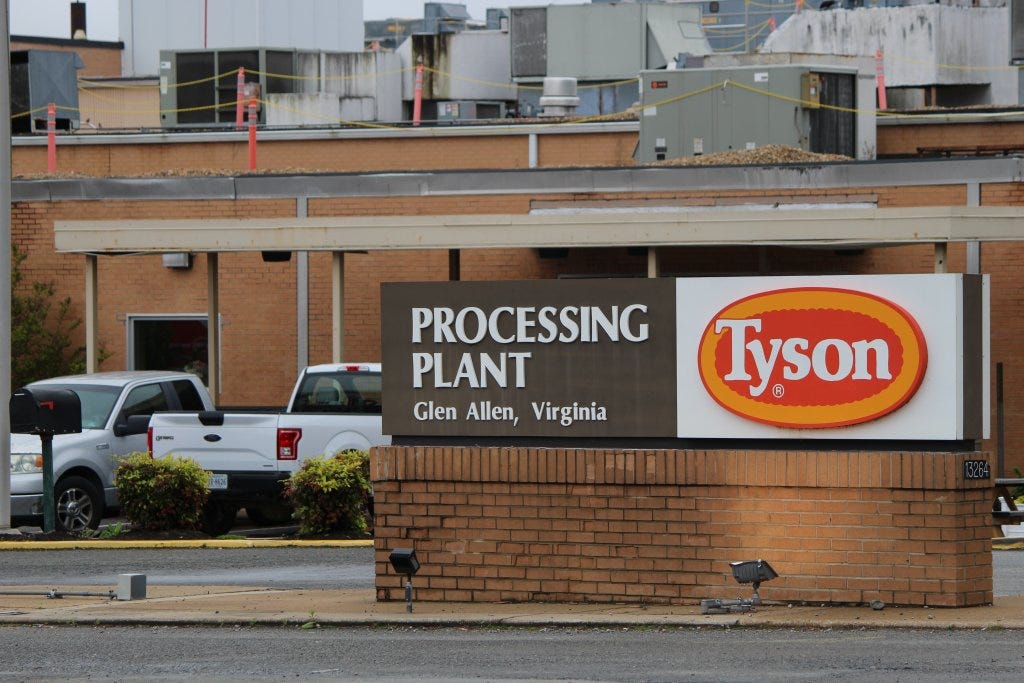
But Tyson Foods closed its Glen Allen broiler processing plant in 2023, putting 57 central Virginia farmers out of the broiler chicken business. Tyson Foods’ 2025 sales were $54.4 billion; it’s the largest poultry producer in the US and perhaps the world. Their closure announcement cited “inability to economically improve operations” at the processing plant. Just five words that Tyson got to define, and 265 Virginia poultry houses on Virginia farms were empty. It wasn’t just farmers who lost income. The plant closure left almost 700 poultry processing workers unemployed. Farmers growing feed inputs, propane suppliers, and equipment vendors also lost income. The National Association of Development Organizations (NADO) Research Foundation estimated that our regional economy lost $358 million/year in the wake of the Tyson plant closure.
We won’t find out until the 2027 USDA farm census (done at 5-year intervals) what the damage is at the county level, but monthly state-level surveys show that Virginia’s broiler chicken production has fallen to eleventh. The 2025 state broiler count is 46M fewer than in 2022, a decline of about 16%. That’s just one processing plant. Just one. Why so big an impact?
Those of you who are not poultry farmers may need a little context for what is happening in the industry. Over the past 35-plus poultry production has increasingly “integrated.” Today, 90% of some 9 billion chickens “grown” from chicks (poults) to slaughter weight under contract. I’ve covered this transition in prior newsletters (Happy Turkey Day - by Kristin Farry - Someone Grew That and Turkey on My Mind - by Kristin Farry - Someone Grew That). My earlier newsletters took a turkey slant, but chicken production is on the same path, perhaps ever-so-much-more-so.
Poultry farmers have been demoted to “growers” for “integrators” (really processors). The top four integrators (Tyson Foods, Pilgrim’s Pride, Sanderson Farms, and Perdue Foods) control 60% of the market. The only place they call the people who raise the chicks to maturity “farmers” is on their consumer-facing websites. Everywhere else, they are called “growers.” The integrator provides chicks, feed, medications, and technical support. The grower provides a facility built to the integrator’s specifications and the labor required to “grow” those chicks to slaughter weight. The integrator (in theory) guarantees an up-front price for the finished birds.
The integrator takes on feed price risk, processed chicken market price risk, and genetic performance (conversion of feed to mature poultry weight) risk. The grower takes construction cost risk, utility cost risk, weather risk, and labor cost risk. Growers typically carry large construction loans—secured by the farmland underneath—on poultry houses. Broiler house construction costs run from $17.50 to $25 per square foot, and integrators prefer multiple houses over 30,000 square feet each. That’s a mortgage in the millions! Some integrators offer multi-year contracts to mitigate the risk of taking on these huge construction loans—but many have reserved the right to add facility requirements during the contract periods, which the grower must pay for.
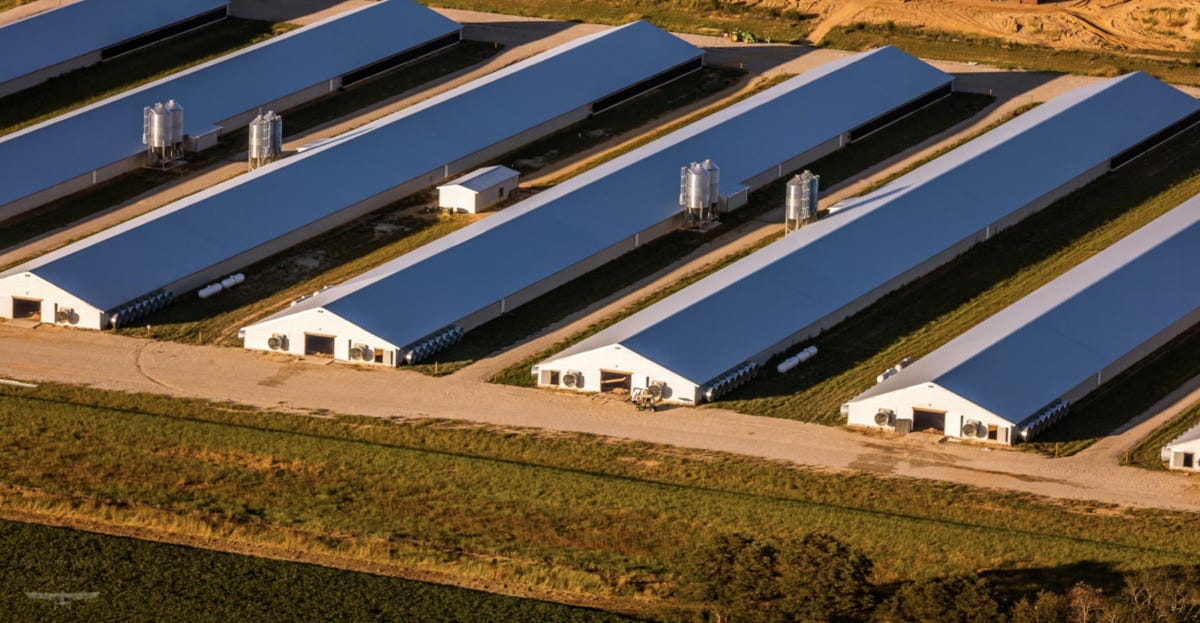
Unfortunately, upfront price for the finished birds that a grower is not really “guaranteed” in the sense that most of us think of guarantees. Many integrators use a “tournament system” to reward the top-performing growers at the expense of lower-performing growers. A little competition will increase efficiency, right? The problem is that the contract poultry grower has no control of the inputs other than labor. Furthermore, until February 2024, the growers did not know the tournament rules. The integrator used the tournament system to push some of the risk it had agreed to assume back onto the grower. To compound the grower’s risk, integrators also control the number and quality of chicks placed with each grower.
Comedian John Oliver nailed it: “You [the farmer] own the property and the equipment, we [the company] own the chickens. That essentially means you own everything that costs money and we own everything that makes money.” His sketch is on YouTube (Chickens: Last Week Tonight with John Oliver (HBO)). It’s a laugh-to-keep-from-crying piece.
Growers have long suspected that integrators manipulate chick placements, tournament formulas, and facility upgrade requirements to force growers out of business to reduce supply commitments when meat prices drop. Or to punish growers who questioned their contract terms or payments. Or supported government efforts to regulate integrators. Over 70% of growers earn less than the federal poverty line. The stress is incredible. The suicide rate among crop-producing farmers is 1.38 times the national average. Everyone in the poultry business knows someone who has killed themselves or died in a suspicious accident.
Why don’t farmers just switch to another integrator? Grower contracts frequently required that the grower pay large contract termination fees—essentially non-compete provisions. Worse, the integrators have divided up the US into regional monopolies (the technical term is “monopsonies”) so that growers in any given region have only one integrator buying their birds. There’s a limit to how far you can humanely transport live birds. This is why 57 Virginia poultry farms are now either transitioning to egg production or getting out of poultry altogether. It can cost about a million dollars to convert a typical broiler house to cage-free egg production. You have to add a concrete floor and a lot of equipment. Figure $20-$25 per laying bird for the conversion. That’s a tough transition when your poultry income just went to zero and you are still paying the first construction loan.
In some states, the poultry industry’s vertical and horizontal consolidation exceeds the anti-trust enforcement thresholds by a factor of 2 or 3. But government anti-trust action has been slow in coming to poultry. The Department of Justice (DoJ) began collaborating with the USDA in investigating anti-competitive behavior in the poultry industry sometime in 2020. In 2021, the number three poultry integrator—Pilgrim’s Pride, a subsidiary of Brazilian giant JBS—pled guilty in a price-fixing case (United States v. Pilgrim’s Pride Corporation) and paid a $108M fine. Number one integrator Tyson Foods was involved in that price-fixing scheme, but Tyson co-operated with the government investigation to avoid criminal charges. DoJ also won a case against Koch Foods Inc. to halt grower contract termination fees that ran as high as half of the contract’s prior payments (2023). Other DoJ actions resulted in compensation to poultry processing workers whose wages were depressed by integrator collusion. They also investigated the integrators’ opaque grower contracts, tournaments, and retaliation against growers who filed complaints. Most of these efforts appear to have resulted in integrators agreeing to stop their anti-competitive policies. A Memorandum of Understanding (MOU) finally “formalized” this Agricultural Markets Enforcement Partnership in 2025, although it appears that MOU is actually just announcing an enforcement shift away from farm product buyers to farm crop inputs (seed, equipment, feed, fertilizer, fuel, etc), as DoJ and USDA archives mention the Agricultural Markets Enforcement Partnership many times 2020-2024.
Tyson escaped criminal penalties during this 2020-2024 enforcement flurry, but not civil penalties. A coalition of poultry buyers and consumers sued integrators in 2016, (In re Broiler Chicken Antitrust Litigation) alleging collaboration to control poultry supply back to 2008. The largest integrators settled out of court, paying hundreds of millions in civil fines. Tyson’s portion of the settlement was $221M. Pilgrim’s Pride settled for $75M. These settlements were only about 0.5% (1/200th) of these integrators’ 2021 revenue. Another civil case on behalf of 2013-2019 broiler growers is still in progress but looks to have a final judgment over $200M. Growers won a much smaller settlement ($37.5M) from Tyson and Perdue Farms over their agreement to not hire growers away from each other.
Farmer-grower organizations including the Campaign for Contract Agriculture Reform (CCAR) finally pressured the USDA into specific regulatory action. In 2022, the USDA began its third attempt this century to protect farmers from integrators under the authority of the Packers and Stockyards Act of 1921 (7 U.S.C. §§ 181-229b), which “prohibits unfair or deceptive practices, giving undue preferences, apportioning supply, manipulating prices, or creating a monopoly” in the meat industry. The lengthy rulemaking process included farmers, integrators, and processed poultry buyers including consumers. Three rules came out of that process, summarized in this table:
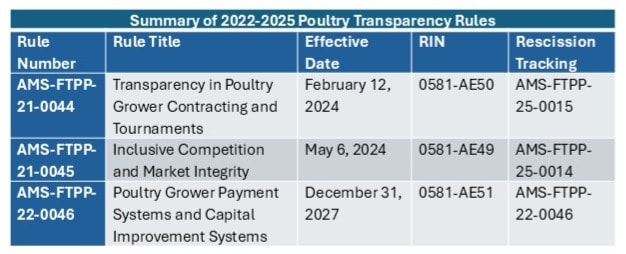
The first rule—Transparency in Poultry Grower Contracting and Tournaments (AMS-FTPP-21-0044)—became effective in February 2024. This rule requires that integrators tell growers the minimum number of chicks the integrator must provide the grower (the placement”) and how they rank grower performance for determining payment (the “tournament”). The contract clarifications provided under this rule revealed that integrators are not in fact guaranteeing growers enough bird placements to pay off the farmers’ required facility investments. The financial security that farmers thought they were getting by giving up their independence to become a contract grower was an illusion.
The second rule—Inclusive Competition and Market Integrity (AMS-FTPP-21-0045)—went into effect in May 2024. It “prohibits employing false or misleading statements or omissions of material information in contract formation, performance, and termination; and prohibits regulated entities from providing false or misleading representations regarding refusal to contract.” (from the USDA Summary) This second rule also prohibits discrimination or retaliation against growers for exercising rights granted by the Packers and Stockyards Act. These rights include exploring contracts with competitors, joining cooperatives, and asking for information about one’s own contracts.
The third rule in the series—Poultry Grower Payment Systems and Capital Improvement Systems (AMS-FTPP-22-0046)—was published on January 16, 2025, with July 1, 2026, as its original effective date. This rule would have required the poultry integrators to tell growers how payments are set and how their performance is measured. It also would have required integrators to give a grower a clear “base price” that the grower can use to decide how deep into debt he can go on the facilities investment. High-performing growers could still receive bonuses, but not at the cost of putting their neighbors out of business. The rule also would require integrators to clearly justify facility capital improvement requirements to be made at the growers’ expense.
I say “would have” because this past March the Trump Administration postponed the date that this third rule would become effective to December 31, 2027. This month, buried in the Current Unified Agenda of Regulatory and Deregulatory Actions (the comprehensive list of regulatory actions published by the Office of Management and Budget (OMB) Office of Information and Regulatory Affairs) is RIN 0581-AE51 (under the original rule designation of AMS-FTPP-22-0046), the Trump Administration’s proposal to rescind this third rule. The official rescission reasons are: n(1) the rule will increase prices consumers pay for poultry because the rule’s added cost to integrators is almost $5M/year and the cost to growers about $249,000/year and (2) integrators will lose growers and be unable to recruit new growers to replace them. So, an industry with an estimated single-year revenue of $122.7 billion (2022) which has admitted to price-fixing and collusion will be excessively burdened by 5 cents out of every $1000 of revenue? The estimated cost to growers—apparently time required to read the additional contract transparency clauses and do the break-even math—is about $7.70/grower/year. The important reason is the second (2). Better-informed farmers may decide to do something else with their time and land—remaining truly independent farmers—instead of essentially becoming subsidiaries of multi-billion companies. Recall that the Small Business Administration ruled in 2018 that contract growers were subsidiaries of integrators, not independent businesses, for the purpose of government loans.
But wait! The Unified Agenda also includes notices proposing rescission of the first two transparency rules. RIN 0581-049 proposes eliminating AMS-FTPP-21-0045 under a new rulemaking effort AMS-FTPP-25-0014. RIN 0581-050 proposes eliminating AMS-FTPP-21-0044 under a new rulemaking effort AMS-FTPP-25-0015.
Why would the Trump Administration place the interests of these giant integrators over 32,300 poultry farmers and 330 million poultry consumers? Through the entire rule-making process, these three rules had bipartisan support in congress. The integrators’ lobby in congress tried to attach riders to the 2024 USDA appropriations bill to block these rules, but that effort was defeated. What was the integrators’ Plan B to defeat these new rules?
In 2025, Pilgrims Pride gave the largest single donation to President Trump’s inaugural fund ($5M). Mountaire’s owner (Ron Cameron) donated $5M to Trump political action committees and $29M to other Republican PACs since 2016. Mountaire and its employees are exceptionally active in politics, being ranked 46th on the OpenSecret’s top 100 donor list for 1990-2024 with $79.7M ($10.4M to candidates and $69.2M to lobbying and groups).
Tyson Foods has kept a lower political profile, with OpenSecrets showing political campaign donations totally only $3.1M in the past 10 years, with about two thirds going to Republicans and one third to Democrats. The integrators’ lobby—the National Chicken Council—has donated a little less than $2M to political candidates over the same period, with over 80% going to Republican candidates. Unfortunately, we also know that sources of “super PAC” donations are increasingly shielded from disclosure, so these numbers need to be taken with some salt—or at least with the understanding that big donors can easily escape tracking. I was unable to find political contribution data on many top ten integrators, and I find it hard to believe that all of them stay completely out of politics.
To Tyson’s credit, they bought out grower contracts in central Virginia affected by the Glen Allen plant closure. The amounts of the settlements are not public, but scuttlebutt at Poultry Services, Inc. in Amelia says that no one around here lost their farm. That gossip is more reliable than average feed store gossip because Poultry Service, Inc., is very busy converting broiler houses to cage-free egg houses. The Chapter 12 bankruptcy filings in Virginia did not rise 2023-2025, confirming the scuttlebutt.
In parallel, Tyson received $7.2M in grants to open a new 325,000 sq ft plant in Pittsylvania County (about a hundred miles southwest of Amelia County). These grants came from Virginia’s government Commonwealth Opportunity Fund ($3M), Virginia Investment Performance ($3M), the Governor’s Agriculture and Forestry Industries Development Fund ($0.5M), and the Tobacco Region Opportunity Fund ($0.707M). The company emphasized that the new plant was in work before the Glen Allen plant closure. Despite the new plant employing 320 fewer people than the closed plant, Tyson’s new plant is eligible for state job creation tax credits. The new plant (opened in late 2023) produces more highly-processed, fully-cooked chicken products like nuggets, while the Glen Allen plant was general uncooked chicken processing.
During my campaign for Virginia House of Delegates in 2025, I made an issue out of Tyson getting over $6M in grants plus tax credits while our district’s farmers got only $1.8M in grants to form a cooperative to transition from raising broilers to producing eggs. I can’t draw a clear line between that campaign dust-up and additional grants, but the incumbent who won reelection acknowledged that I brought this to his attention. This year, he announced an additional $0.54M in grants with great fanfare and his picture. So perhaps my effort to bring attention to rural economy issues has not been a total waste. In the meantime, former broiler farmers here are building relationships with multiple egg wholesalers, with many finding private financing to convert their facilities (about $1M per broiler house).
Midwesterners are likely considering some angry comments on this newsletter by now, to remind me that the Tyson plant closure story went well beyond central Virginia. Across the US, Tyson Foods closed five other poultry processing plants in their 2023 restructuring: Van Buren, Arkansas; North Little Rock; Arkansas; Noel, Missouri; Dexter, Missouri; and Corydon, Indiana. Two beef and pork plants were also closed: Jacksonville, Florida and Columbia, South Carolina. Some 4,200-4,600 processing workers lost their jobs in those eight plant closures. Consolidating meat processing into fewer plants increases supply chain vulnerabilities. More plant closures followed in 2024-2025, for a total of over 7,000 unemployed meat industry workers.
Reports from other states suggest that Tyson’s contract-grower buy-outs were not as generous as they were here in Virginia. Two of the Tyson plant closures were in Arkansas, the third largest chicken producer. Arkansas is Tyson’s home state. Chapter 12 (farm and fisherman reorganization) bankruptcies in Arkansas rose dramatically, accounting for 30% of the US total in 2024 and 26.8% in 2025. The US Courts Bankruptcy summary does not separate Chapter 12 bankruptcies by commodity, so I can’t say how many of the Arkansas bankruptcies were poultry farmers, but that may be an artificial distinction. Farmers growing grain and soybeans lose customers when their neighbors’ poultry houses are empty, because the poultry feed mills stop running. Missouri—home of two other closed Tyson plants—also saw a significant rise in chapter 12 bankruptcies 2023-2025. In fact, the 8th District of US Bankruptcy courts—covering Arkansas, Missouri, Nebraska, Minnesota, and the Dakotas—led the nation in Chapter 12s, and not by a little. The district had 18% of Chapter 12s in 2022, 23% in 2023-2024, and 32% in 2025. Those numbers likely represent turmoil across the meat industry, not just poultry, because there’s a lot of beef in that district. That district has also suffered a lot from recent tariffs.
Tyson has made the wrong kind of news in southern Missouri, where lawsuits from growers have revealed the purchase agreement with Cal-Maine for the Dexter, MO, plant. The agreement prevented the purchaser from using the facility to process broiler chickens for 25 years. Tyson also shared sensitive details with Cal-Maine on its contract growers. Tyson also required Cal-Maine to offer egg-production contracts to those growers with a condition: the grower had to agree to not sue Tyson over their Tyson contract terminations. This restriction came on top of the expense of converting broiler facilities to egg production. During these court cases, Tyson has demanded that the growers disclose all contacts with the US government and journalists. So, were the Tyson plant closures only about plant inefficiencies to shore up its balance sheet or also about limiting total supply?
These three rules mostly state the generally-accepted contracting practices that other industries take for granted. Why do we need them? Decades in farming made me a regulations skeptic, but after three years of following this, I think the poultry integrators have been the only real winners before these rules began to roll in. These rules provide a handle with which to hold Goliath accountable to David, without farmers resorting to an expensive, lengthy lawsuit.
It may be too late for our central Virginia poultry broiler industry, but another 32,300 US poultry farmers will appreciate your taking a few minutes to express support for this transparency to our elected representatives. And please watch for the opportunity to comment on the rule rescission dockets (AMS-FTPP-25-0014, AMS-FTPP-25-0015, and AMS-FTPP-22-0046) when they open for comment. The outcome will affect pork as well as poultry. A truly transparent, competitive market will benefit anyone who eats, too—and I assume you all like to do that. My farm neighbors are hoping you will eat more eggs.
Sources:
Industry Overview, with Humor: Chickens: Last Week Tonight with John Oliver (HBO)
USDA National Agricultural Statistics Service (NASS) Census: List of Reports and Publications | 2022 Census of Agriculture | USDA/NASS
UDA NASS “Quickstats” Query Site:
https://quickstats.nass.usda.gov
World Population Review: Chicken Production by State 2026
Poultry Grower Contracting Guide: Broiler Contract Farming Guide | Poultry Log
Poultry Industry Grower Concerns Summary (Food Whistle Blower): Contract-Growing-Fact-Sheet_FINAL.pdf
Poultry House Construction Costs: How Much Does a Commercial Chicken House Cost? - ScienceInsights
Grower Contract Termination Penalties: Office of Public Affairs | Justice Department Files Lawsuit and Proposed Consent Decree to Prohibit Koch Foods from Imposing Unfair and Anticompetitive Termination Penalties in Contracts with Chicken Growers | United States Department of Justice
Grower Intimidation: Big U.S. chicken company, Mountaire, asks contractors to oppose transparency rule | Reuters
Anti-Trust Actions:
Pilgrim’s Pride to pay $75M in plea with DOJ | 2021-01-11 | MEAT+POULTRY
Tyson Chicken Lawsuit Reveals Poultry Price Fixing Scandal
Tyson Plant Closure in Virginia:
Poultry Cooperative Receives $538,083 Grant From State - The Crewe-Burkeville Journal
Virginia Plant Closure Impact Assessment:
About NADO Research Foundation - NADO
Other Tyson Plant Closures:
Tyson closes 3 meat plants, lays off 1K workers | Agriculture Dive
Which Tyson Chicken Plants Are Closing: Complete Shutdown List & Impact
What you need to know about Tyson’s former contract growers - Investigate Midwest
Farmers sue Tyson over Dexter, Missouri, plant closure | WATTPoultry.com
US Bankruptcy Court: Bankruptcy Filings Statistics
Arkansas led nation in Chapter 12 farm bankruptcy filings in 2025
Chapter 12 bankruptcies surge; Arkansas leads the way
USDA Fair Trade: Fair Trade Practices Program | Agricultural Marketing Service
Recent USDA Poultry Transparency Regulations:
AMS-FTPP-21-0044: Transparency in Poultry Grower Contracting and Tournaments | Agricultural Marketing Service
AMS-FTPP-21-0045: Inclusive Competition and Market Integrity under the Packers and Stockyards Act | Agricultural Marketing Service
AMS-FTPP-22-0046: Poultry Grower Payment Systems and Capital Improvement Systems | Agricultural Marketing Service
AMS-FTPP-22-0046 Delay: Federal Register :: Poultry Grower Payment Systems and Capital Improvement Systems; Delay of Effective Date
Regulation Information:
Summary of 2026 Regulatory Actions: Current Unified Agenda of Regulatory and Deregulatory Actions
General Search for Regulatory Actions for Comment: Regulations.gov
Rescission Notices:
Inclusive Competition and Market Integrity Under the Packers and Stockyards Act - Rescission (AMS-FTPP-25-0014): View Rule
Transparency in Poultry Grower Contracting and Tournaments - Rescission (AMS-FTPP-25-0015): View Rule
Poultry Grower Payment Systems and Capital Improvement Systems - Rescission (AMS-FTPP-22-0046): View Rule
Rural Advancement Foundation International: RAFI Statement on P&S Rules Rescission - RAFI
USDA Proposes Scrapping Protections for Poultry Farmers | Civil Eats
Poultry Integrators Financials:
Tyson Foods Inc. - Tyson Foods Reports Fourth Quarter And Fiscal 2025 Results
Pilgrim’s Pride Reports Fourth Quarter and Year-End 2025 Results | Pilgrim’s Pride Corporation
Political Contributions:
Popular Information Substack: Massive giveaway to Trump donors buried in obscure government document
Tyson Foods Profile: Totals • OpenSecrets
TYSON FOODS INC POLITICAL ACTION COMMITTEE (TYPAC) - committee overview | FEC
Mountaire Corp Profile: Summary • OpenSecrets
Mountaire FEC Records: Browse Individual contributions | FEC
Top Organization Contributors • OpenSecrets
AntiTrust and Price-Fixing Actions:
Tyson Chicken Lawsuit Reveals Poultry Price Fixing Scandal
Home | Broiler Growers Antitrust Settlement
Grower Advocacy:
Campaign for Contract Agriculture Reform (CCAR)
Who’s Who in Deregulation:
Other:
Suicide Rates by Industry and Occupation — National Vital Statistics System, United States, 2021