


It’s Thanksgiving and many of us are eating turkey sometime today as part of a gathering of family or friends. I hope that some of my neighbors are NOT going to be cooking a turkey on Thanksgiving Day because they paid their dues in another kitchen this week: preparing the 17th annual Amelia Community Thanksgiving Dinner. While I don’t yet know the total number of meals served yesterday, in recent past years it’s been over 750.
Noell Berry, one of the members of the Terrapin Neck Grange that I joined this past spring, organizes this. The Grange joins many other organizations across the community to pull this off. It takes place at the local Veterans Center. This was my first time to participate. My “homework assignment” was sugar-free desserts. I inflicted several test recipes on my church friends over the past few weeks. With my allergies, I’ve learned to bake almost anything without one or more major allergens, but no-sugar baking almost defeated me. Fortunately, my church friends were willing to taste test and give me honest feedback. I finally managed to stagger into the Veterans Center on Tuesday with three trays of better-than-just-edible sugar-free brownies. I was soon drafted into a massive cooking and food packaging operation already in progress.
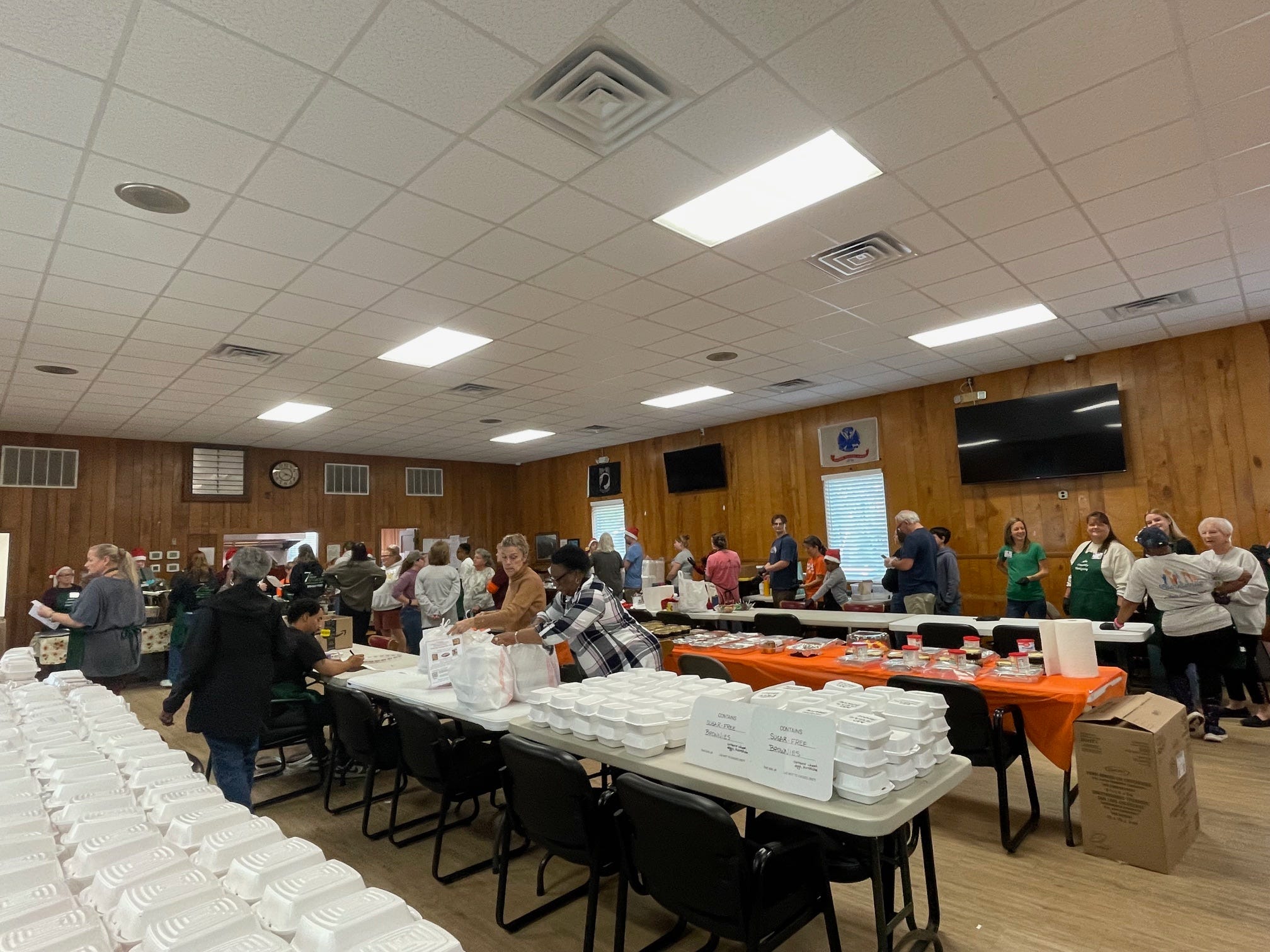
On Wednesday morning, I returned to become a very small part of the relay to get several hundred hot meals assembled with the desserts and rolls packaged the day before (Photo 1). We bagged and loaded the meals into volunteers’ vehicles so they could deliver this bit of holiday to those who could not make it to Veterans Center. It was fun to see how people sorted themselves into various jobs with Noell directing traffic with her multi-colored spreadsheets. Many people also came to enjoy the food in person. Oh, and on the side was another boxing and delivery operation of edible holiday treats going to families whose budgets do not have room for treats.
One of the benefits of having campaigned for office this year—yes, that’s why you haven’t seen a post here since July—is that I now know a lot of the people gluing this community together with events like this. Sadly, I also learned how many neighbors had their only holiday dinner today, delivered from this event. I’ve started compiling that experience for a future post on rural poverty. But today, I want to update you all on the turkey part of our holiday tradition, as it’s been two years since my 2023 series on turkeys.
In my first 2023 post dedicated to turkey—Ghosts of Turkeys Past - by Kristin Farry—I traced the path from the wild turkey domesticated by the Aztecs and Anasazi over two thousand years ago to our modern Thanksgiving Day table bird. It’s a winding journey that runs from what has become Mexico and the Southwest US through Europe and back to the Americas with the first European Settlers at Jamestown. An Aztec Tlatoque (leader) with a time machine (or perhaps one of the divine powers he claimed to have) would not be surprised to see a turkey in the center of our holiday tables in 2025. Turkey was a major staple of the Aztec empire as well as one of the personifications of their Trickster God Tezcatlipoca.
That June 2023 post also reviewed turkey prices through the past century. Adjusted for inflation, turkey has become a bargain. It’s also not just for holidays anymore. Americans’ poultry consumption has exceeded our beef consumption since 1992. Poultry consumption numbers include chicken, duck, goose, and turkey. But it seems that we’ve been replacing some of our turkey in our diets with chicken the last few years. Both our consumption of turkey and US turkey production have declined in the 2020s. This year, the number of turkeys raised on US farms is about 195 million birds. The US turkey population has been declining since its 302.7 million-bird peak in 1996, but the decline accelerated recently. The 2025 bird count is 64% of that 1996 peak.
At the same time, our total consumption has increased. Genetic, feed, and veterinary science improvements have made it possible for us to increase our consumption with fewer birds. That said, our per capita consumption peaked at 18.1 pounds per person in 2008 and has declined to a projected 13.1 pounds per person this year. That’s a modest (4-ounce) serving of turkey per week. With beef prices going up, we’re filling in the gap with poultry, mostly chicken. Maybe we’ll prove the experts wrong on 2025 turkey consumption estimates considering beef prices are not coming down, what with the US brood cow population at the lowest it’s been in 70 years.
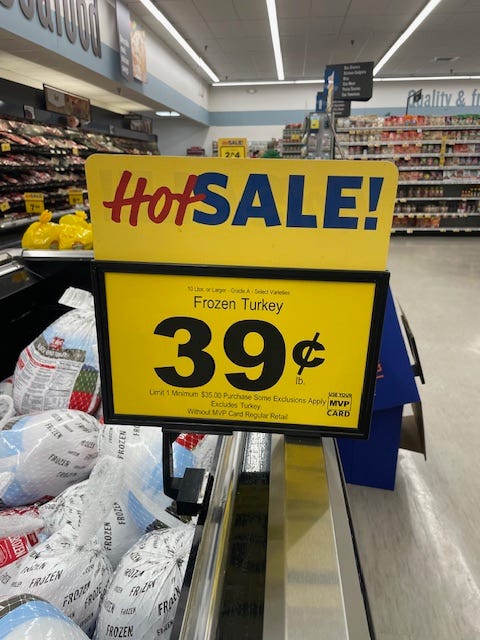
I planned to update my 2023 chart of grocery store turkey price corrected for inflation to include 2025, but I got bogged down. Key sources are disagreeing on turkey prices in the past few years, have stopped analyzing turkey prices, or were delayed by the government shutdown. Also, November is the wrong month to analyze the current year’s turkey prices, because there’s a big supply. All the farmers and integrators are aiming for the holidays and grocery stores use the turkey as a loss leader. A sign advertising whole turkey just 39 cents a pound greeted me at my closest grocery store on Tuesday.
To get an idea of just how great a bargain this is, consider that the wholesale price of these turkeys—what the grocery store paid for them—has been running about $1.32 per pound. That was about 40% more than last year, due to the loss of over 3 million birds to avian flu this year. So, my local grocer is losing at least $0.91 per pound on these birds—more if you count the handling and cold storage between delivery and that display.
Just in case you had any doubts about the best time of year to buy turkey, Graph 1 shows the retail price history for whole frozen turkeys for four decades (1980-2020). The notches in that sawtooth? November of every year.

The grocery store is betting that you’ll buy all the sides and trimmings on the way to snare this turkey. The fact that the grocery store calculated that they are likely to make the $12.74 they lost on that turkey back on sides and trimmings tells you something about the holiday markup on those items.
Sorry, Food Lion, I have a garden. Good thing, too, as sweet potato prices are up 37% over last year because the North Carolina sweet potato crop got stomped by Hurricane Chantal. North Carolina is the number one sweet potato producer, growing over twice as much tonnage than number two (California). Because that blank-blank ground hog chewed up everything growing above ground in my garden except the hot peppers, sweet potatoes are the only thing the garden gave me to make pies out of. My friends are getting sweet potato pie instead of pumpkin pie for Thanksgiving. And sweet potato casserole. And sweet potato soup. And sweet potato chips. Well, not all at the same meal. I’ll inflict my sweet potato bonanza on my friends at Christmas, too, as I have been canning what I can’t foist on them around Thanksgiving.
I am telling my friends that serving sweet potatoes with turkey is truly an American tradition because sweet potatoes were first domesticated in Central American and northern South America. So the Incas were probably eating sweet potatoes 2000 years ago with the turkeys they got from their Aztec neighbors. And guess who took sweet potatoes to Europe? The Spanish Conquistadores. I’ll let you guess how they got to US territory.
The smart folks just down the road from me at Virginia State University (VSU) have also figured out that sweet potatoes grow well here. They are testing various varieties and growing techniques on their ag research campus, Randolph Farm. Here’s one of their sweet potato research fields, a few months ago (Photo 2):
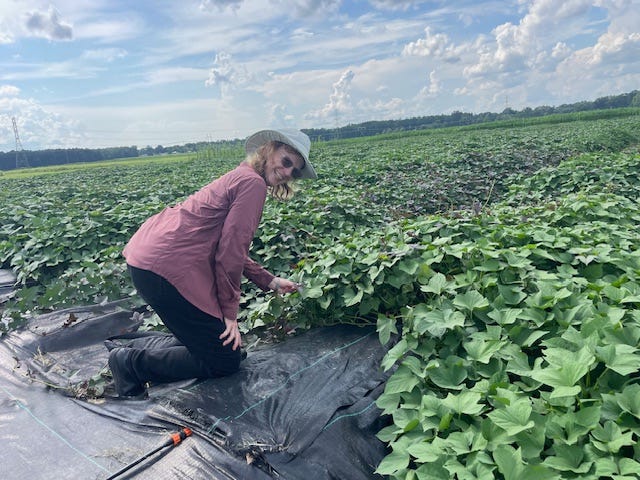
And no, my sweet potatoes didn’t stay so well organized. The vines ran all over the place, Bambi permitting (the deer love sweet potato vines). Fortunately, there’s some compensation for face-plant when you trip on the sweet potato vines twenty feet from where you planted them: A close-up view of pretty flowers. Sweet potatoes are related to morning glories and they look the part in late summer. One fun thing about VSU is the Ag school teams up with the Hospitality Management program, which puts their students to work figuring out creative ways to cook or ferment what the ag students are growing. More recipes to inflict on my long-suffering friends!
We can’t clearly blame a hurricane for price increases in other vegetables. A labor shortage from the current immigration enforcement policy has reduced domestic vegetable production while tariffs are making imports an expensive way to fill the gap in domestic production. The labor shortage is affecting food processing as well. Wholesale prices for some vegetables increased almost 40% this summer. On the other hand, the trade war has reduced export markets of some major commodities, lowering domestic prices for the feed that your future meal—be it poultry, pork, lamb, or beef—is eating. This combination is making analysis hard. Stay tuned and I will sort this out eventually.
My November 2023 post about turkeys—Happy Turkey Day - by Kristin Farry - Someone Grew That —covered choosing your bird at the grocery store, without paying extra for a story that’s not true. Bottom line: Don’t believe the marketing machine trying to convince you that their birds were raised by “independent family farms.” Sadly, most poultry farmers (called “contract growers”) are still caught in a vise created by poultry processing giants (called “integrators”).
But I’m happy to report a little progress toward restoring poultry farmer independence since I published that article in November 2023. The “Poultry Grower Payment Systems and Capital Improvement Systems” rule-making process that I mentioned in that post has run its course. USDA published three new rules from it under the authority of the Packers and Stockyards Act of 1921 (7 U.S.C. §§ 181-229b; P&S Act). According to Wikipedia, this 1921 Act “regulates meatpacking, livestock dealers, market agencies, live poultry dealers, and swine contractors to prohibit unfair or deceptive practices, giving undue preferences, apportioning supply, manipulating prices, or creating a monopoly.” Well, good to know that these new rules are well within the authority of this landmark law—but inquiring minds are wondering how we got to these regional monopolies (technically monopsonies) in the last 50 years with this law on the books for over a century!
The first rule—Transparency in Poultry Grower Contracting and Tournaments—became effective in February 2024. While the contract grower system remains intact, the integrators must now make their contracts much more transparent to growers. The rule requires that integrators tell growers the minimum number of chicks the integrator must provide the grower (the “bird placement”) and how they rank grower performance for determining payment (the “tournament”). The contract clarifications mailed to growers since then have been eye-opening. Or maybe I should say eye-watering. The grower contracts conforming to this transparency rule revealed that integrators are not actually guaranteeing growers enough bird placements to pay off the farmers’ facility investments. Remember that the farmers had to build facilities at their expense to the exact specifications of the particular integrator as a condition of the contract. This generally involves the farmer mortgaging the farm to pay for these up front for contracts averaging ten years. So, the financial security that farmers thought they were getting by giving up their independence to become a contract grower for a large poultry company was an illusion.
The second rule—Inclusive Competition and Market Integrity—went into effect in May 2024. It “prohibits employing false or misleading statements or omissions of material information in contract formation, performance, and termination; and prohibits regulated entities from providing false or misleading representations regarding refusal to contract.” I guess the USDA needed a hammer to drive the basic point of a contract home to integrators, and this is the hammer. Individual court cases were inconsistent in demands, definitions, and results. The lawsuits all have one thing in common, however: big legal bills. It takes a lot of money to sue corporate giants like these integrators.
This second rule also prohibits discrimination or retaliation against growers for exercising rights granted by the Packers and Stockyards Act. These rights include “lawful communications,” exploring contracts with competitors, joining cooperatives, and asking for information about one’s own contracts. The fact that the USDA decided this rule was necessary is pretty scary, actually. I’ve heard some horror stories, but what I’ve heard is apparently only a tiny sample. Now I know why growers submitted so many comments against this rule that were obviously written by their integrator. They felt they could lose their farm and home if they didn’t take their integrator’s side in this argument.
The third rule in the series—Poultry Grower Payment Systems and Capital Improvement Systems—was published on January 16, 2025. It will become effective July 1, 2026. Growers will soon know more about how the poultry integrators are setting their payments and comparing their performance with that of their competitors. Contracts will have to give the grower a clear “base price” that he can use to decide how deep into debt he can go on the facilities investment. High-performing growers can still receive bonuses, but not at the cost of putting their neighbors out of business. Remember that each grower has no control over critical inputs—including the chicks, feed, and medication—and has had no knowledge of the ranking system that the integrator was using prior to the first tournament transparency rule. In light of that, the USDA concluded that growers should not be penalized to the point of bankruptcy for lower performance rankings when they are essentially “flying blind.” Growers have long suspected that their inputs could be manipulated to reduce grower numbers in gluts. Poultry companies will also soon have to make clear justification for facility capital improvements at the growers’ expense—thus eliminating arbitrary “facility improvement” requirements that some integrators may have used as another tool to reduce grower numbers during the market decline.
There was supposed to be a fourth rule this year—Fair and Competitive Livestock and Poultry Markets—to better define “unfair practices” that the 1921 law prohibited. That rule was cancelled. Hmmmm.
Much as I complain about too many regulations, these rules all originate in tragedies and are good-faith attempts to prevent more. USDA won multi-million dollar settlements from large poultry processors in recent years for violations of the 1921 Packers and Stockyards Act. This included imposing huge termination fees on growers who wanted to change integrators (essentially unlawful non-compete clauses). The problems these rules are trying to solve are real. The balance of power is very much in the large integrators’ favor, as the growers’ farm is essentially a hostage he tries to join with other farmers or look for a better customer. But I am left wondering if these rules are just band aids, because better-behaved monopsonies are still monopsonies. In some states, numerical measures of the vertical and horizontal consolidation of the poultry industry exceed the anti-trust enforcement thresholds by a factor of 2 or 3. If you don’t have another buyer for your perishable product, a contract that plainly states how screwed you are may not be enough to unscrew you. The Sherman Anti-Trust Act of 1890 has been successfully used against poultry integrators—why not more and more often?
Fifty of my farm neighbors who got dumped by Tyson recently would like a word with anyone considering poultry grower contracts. They did everything Tyson asked of them and still found themselves with no market for broilers when Tyson closed the regional processing plant. Fortunately, Tyson was forced to buy them out of their contracts so it appears that everyone landed on their feet, on farms they still own, if barely. Most of them are now learning how to produce cage-free eggs. Most of these farmers still have to convert their facilities to egg production, which is expensive. They are among the reasons I ran for State Delegate this year.
Because even with these new rules, the “independent family farmer” claim on the label of something that also has a Tyson, Cargill, Sysco, Hormel, Pilgrim’s is still a lie. Your grocer freezer contents may vary as these companies have divided up the country. One reason that the Packers and Stockyards Act and the Sherman Anti-Trust Act have fallen short of protecting farmers and consumers? Congress has simply refused to fund enforcement of prior rules limiting monopsonies, market manipulation, and market concentration in meat and poultry. And we have to watch every Farm Bill for riders that repeal these rules and permanently ban them. Someone already tried that trick with these new poultry rules. Open Secrets’ profile on the National Turkey Federation (the integrators’ team) found $3.28 million dollars in lobbying expenditures by that organization between 2010 and 2023. That’s in addition to direct donations to political candidates by integrators.
My third turkey post--What are you gobbling for dinner? - by Kristin Farry—delved into what various labels really mean. Not the brand names, but label like Product of USA, USDA Inspected and Wholesome. I also covered use of hormones or steroids by the US poultry industry—NOT! And I touched on antibiotic use.
I am happy to report great news on food label integrity since that December 2023 post. The USDA completed their rule-making process governing the voluntary use of “Product of the USA” and “Made in the USA” labels. As of January 1st, 2026, these labels—and using the US flag on the label—now actually mean that the animals involved were born, raised, slaughtered, and processed completely in the USA. If it’s an egg, the hens were born, raised, and laid that egg in the USA. So we have another few weeks in the ambiguous zone where a company can still apply that label to any food product where the last step was done in the USA, regardless of where all the rest of that supply line was. But soon, those labels will actually mean what you thought they meant all along. But before you worry about the origin of that turkey already in your oven, remember that the US is a large poultry exporter, so chances are nearly 100% that bird was hatched and raised and processed inside the US.
But if you are serving beef labeled Product of the USA for dinner—well, that cow may have spent its entire life in Argentina. A topic for another day. I am taking sweet potato pie and some of the hot peppers that ground hog left me to go with the turkey that friends are frying for Thanksgiving dinner.
References
Cost of Thanksgiving Dinner Declines | News Release | American Farm Bureau Federation
Thanksgiving Turkey Price Drop Comes Despite Increase In Wholesale Cost: What To Know
Per Capita Meat Consumption:
https://ourworldindata.org/grapher/per-capita-meat-type?time=1992
The 10 Largest Poultry Companies In The United States - Zippia
Turkey Production by the Numbers - National Turkey Federation
Transparency: Protect Poultry Transparency [Opinion] | Poultry News | lancasterfarming.com
Packers and Stockyards Act - Wikipedia
Packers and Stockyards Act | Agricultural Marketing Service
New rules:
Transparency in Poultry Grower Contracting and Tournaments | Agricultural Marketing Service
Federal Register :: Poultry Grower Payment Systems and Capital Improvement Systems
Poultry Grower Payment Systems and Capital Improvement Systems | Agricultural Marketing Service
Cancelled Rule:
Federal Register :: Fair and Competitive Livestock and Poultry Markets
Lobbying:
National Turkey Federation Lobbying Profile • OpenSecrets
Price Data:
Turkey Sector: Background & Statistics | Economic Research Service
Product of the USA and related labels:
USDA Finalizes Voluntary “Product of USA” Rule – National Agricultural Law Center
USDA Finalizes Voluntary “Product of USA” Label Claim to Enhance Consumer Protection | USDA
This article comes at such a thoughtful time, and while it's truly heartwarming to see communities rallying for those in need during the holidays, it also makes one wonder about the year round systemic support that might prevent such intense reliance on these beautiful but concentrated efforts.
Thanks for another detailed analysis, Kristin. Perfect timing to share it on Thanksgiving Day! Nice to know that "Made in the USA" will soon actually mean what it says.